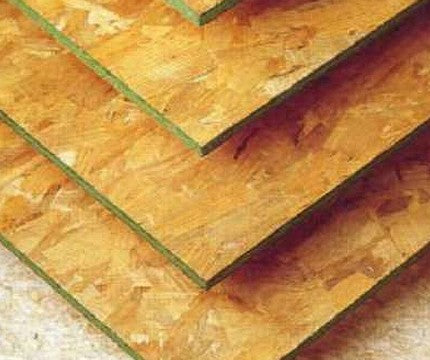
OSB is a wood-derived product made by layering wood strands or fibers in a specific orientation. OSB stands for Oriented Strand Board. It consists of wood fiber compressed under very high pressure to create strand boards. The use of these panels is one of the latest trends in interior design—and for good reason.
The essentials
- OSB stands for Oriented Strand Board: a wood-fiber panel compressed under very high pressure, made from strands oriented in a specific direction.
- Compared with plywood, OSB is generally less expensive, resists moisture just as well, and has greater shear strength.
- It can be left unfinished, painted (including with eco-friendly paint), lacquered, varnished, or treated with natural floor oil.
- In interior design, it can be used on an entire wall, as flooring, on staircases, in kitchens, bathrooms, and furniture.
- It is made from smaller, younger trees, which reduces the demand for wood from high-quality forests.
What is OSB and why use it in interior design?
OSB, or Oriented Strand Board, is a wood-derived panel made from strands and chips compressed under very high pressure in a specific orientation. In interior design, it is appealing because of its low cost, strength, and the distinctive look of its exposed strands, which differ from the layers of plywood.
There are many advantages to using it in the home. It is a competitor to plywood, is generally less expensive, resists moisture just as well, and both materials are strong and durable, but OSB has a superior aesthetic.
What advantages does OSB have over plywood?
OSB allows for greater dimensional tolerances, is manufactured in larger panels than plywood, and has no weak points. It also offers greater shear strength, and its manufacture from younger trees reduces the demand for wood from high-quality forests.
- OSB allows for relatively large dimensional tolerances.
- It is manufactured in larger panels than plywood, allowing it to be used in more spacious interior volumes.
- It has no weak points, such as those found in plywood.
- It is made from smaller, younger trees, which reduces the demand for wood from high-quality forests.
- Finally, it has greater shear strength than plywood.
Should OSB be left unfinished or painted?
Both finishes work well in interior design. Left unfinished, OSB provides a warm contrast in modern and contemporary homes and highlights the texture of a minimalist interior. Painted, lacquered, or varnished, it blends into walls alternating with white or colored plasterboard panels.
OSB can provide a warm contrast in modern and contemporary homes and can be used to highlight the texture of a minimalist interior. “Of course, the panels can be painted, particularly with eco-friendly paint, but we like its unfinished look, which enhances living spaces,” this young Slovak architect tells us. “Moreover, by leaving the natural, oriented wood strands visible, the panels themselves provide a decorative element, thanks to the orientation of the wood chips, whose appearance differs from that of plywood layers.”
Where to install decorative OSB in the home: walls, floors, or furniture?
OSB panels can be installed anywhere: on an entire wall, as flooring, on staircases, in kitchens, bathrooms, furniture, and decorative objects. Designers use them lacquered or varnished on walls, as well as incorporated into office furniture, where their oriented strands create a more intimate atmosphere.
Try it on an entire wall, or use OSB panels for furniture, staircases, or even the construction of decorative objects. The interior-design possibilities are endless and can have a pleasing impact in the home.
Some decorative artists use it in the interior design of public buildings or office blocks with considerable relevance and aesthetic sensitivity. When properly used in the construction of professional offices, OSB panels are a very inexpensive material. Yet a building designed with this initially low-cost material will be considered to have high added value thanks to the elegance it exudes.
If you want to use it to create wood floors with a marble-like appearance and embedded thin wood chips, you can give it a modern, warm look by applying natural floor oils. These can be tinted according to your preferences and coordinated with furniture and textile decorative elements such as curtains, drapes, and tapestries.
Designers sometimes use these lacquered or varnished panels on walls, alternating them with white or colored plasterboard panels and playing with the effects of natural sunlight coming through long glass windows, which create a comfortable and reassuring atmosphere.
They use OSB not only for walls and floors but also for furniture: it exudes remarkable beauty and modernity. The oriented strands of the panel incorporated into office furniture create a more intimate atmosphere. Designer Jack Normand, a specialist in original creations, tells us: “We use OSB to make staircases, kitchens, and bathrooms with saunas, incorporating it into furniture to permanently free users’ minds from its conventional use as flooring, and our clients love it.”
FAQ: OSB interior design questions
What does OSB mean?
OSB stands for Oriented Strand Board. It is a wood-derived product made by layering wood strands or fibers in a specific orientation, then compressing them under very high pressure to create strand boards.
How do you create a decorative OSB wall?
An entire OSB wall is one of the panel’s most common decorative uses. Left unfinished, it provides a warm contrast and highlights the texture of the oriented strands. Lacquered or varnished, it can be alternated with white or colored plasterboard panels to play with natural light.
Should you choose OSB or plywood?
OSB is generally less expensive than plywood and resists moisture just as well. Both materials are strong and durable. OSB stands out for its greater shear strength, lack of weak points, larger panels, and superior appearance.
What finish should be applied to decorative OSB flooring?
For OSB flooring with a marble-like appearance and embedded thin wood chips, apply natural floor oils. They provide a modern, warm look and can be tinted according to your preferences to coordinate with furniture, curtains, drapes, and tapestries.