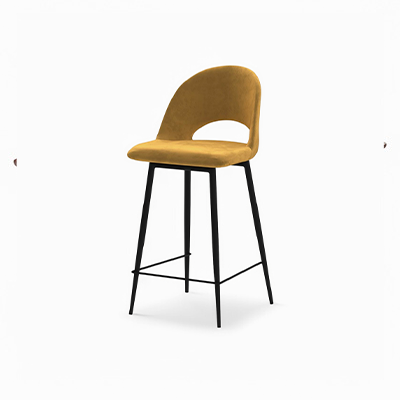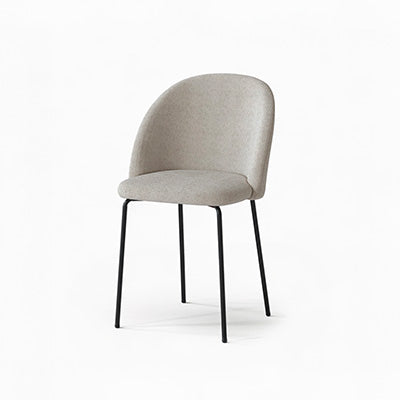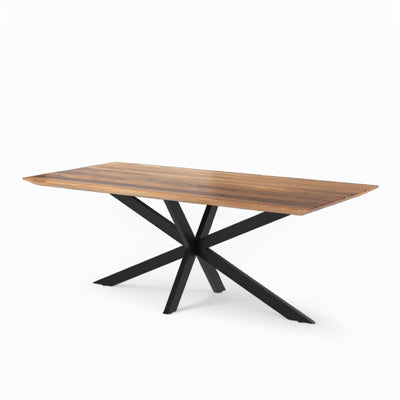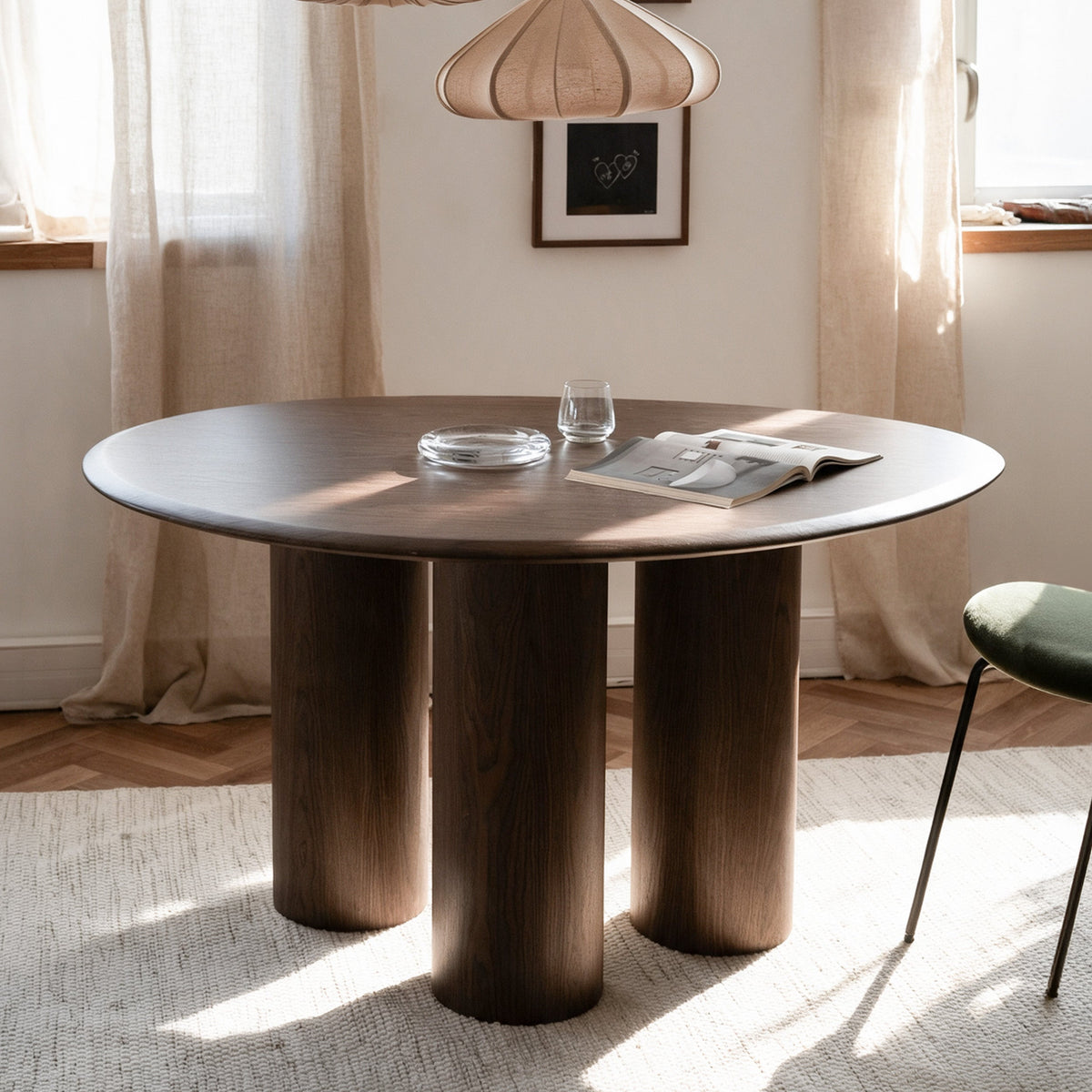
In 2026, trending dining tables focus on four things: rounded shapes (round and oval tables), natural wood, from light wood to walnut-inspired finishes, contrasts between a wooden tabletop and a darker base, and bases with strong, striking volumes. This was confirmed by the September 2026 edition of the Maison&Objet trade show, where organic shapes, heavily grained woods and contrasting materials were everywhere, as noted in an interior designer’s report.
As the centrepiece of the dining room, the table is much more than a functional piece of furniture. Its shape, material and base all contribute significantly to the atmosphere of the room. In 2026, trends are celebrating soft lines, natural materials and designs capable of standing the test of time without losing their character.
Round or oval, light wood or deeper tones, minimalist lines or a more striking base: the possibilities are numerous. The key is to find a trendy dining table that fits naturally into your interior and genuinely suits the way you live.
The essentials
- Round and oval tables are taking centre stage: with no corners, they bring fluidity and conviviality while making movement easier.
- Natural wood remains at the heart of design: light woods for a Scandinavian or minimalist look, walnut-inspired finishes for a vintage influence.
- Contrasts add rhythm: a wooden tabletop combined with a darker base, or a touch of stone or marble.
- The base has become a key design criterion: sculptural volumes, slender legs to visually lighten a large tabletop, and a central base for easily positioning chairs.
Which dining table shapes are on trend in 2026?
Rounded shapes continue to take centre stage in interiors. After several years dominated by very straight lines, round and oval tables bring a sense of fluidity and conviviality that is particularly sought after.
The round table, for a convivial dining room
With no corners or true head-of-table positions, a round table naturally encourages conversation. Visually, it also softens the lines of a room filled with numerous rectangular pieces of furniture.
The round table easily finds its place in a small dining room or an open-plan space, where its silhouette helps maintain smooth circulation. Placed beneath a pendant light or paired with a round rug, it also becomes a true focal point in the room.

The oval table, combining softness and generosity
The oval table echoes the curves of a round table while offering greater length. It is therefore an appealing alternative for those who enjoy entertaining but do not want to return to the more traditional lines of a large rectangular tabletop.
Its less formal profile immediately gives the dining room a more contemporary look. It is also easy to pair with chairs featuring rounded backs or textured materials to reinforce this sense of softness.
The rectangular table, for large gatherings
More classic, the rectangular table remains a popular choice. In 2026, it is evolving mainly through the use of materials, proportions and bases. It remains particularly well suited to large gatherings and long dining rooms.
To give it a more contemporary appearance, choose simple lines and a tabletop whose material adds texture and depth. The challenge is to find the right balance between functionality and personality.
| Shape | Advantage | Ideal for |
|---|---|---|
| Round table | With no corners or head-of-table positions, it encourages conversation and softens the lines of the room | Small dining rooms, open-plan spaces, four people |
| Oval table | The curves of a round table with greater length | Entertaining while maintaining a soft, contemporary silhouette |
| Rectangular table | Easy to use for structuring an elongated room | Large gatherings, long dining rooms |
Which materials and finishes should you choose for a trendy table?
Natural materials remain at the heart of the trendy dining room. Wood occupies a central place: its tones, grain and irregularities immediately warm up the room while remaining easy to pair with different styles.
Natural wood, still at the heart of interior design
Light, golden or deeper in tone, wood can create very different atmospheres. Light-coloured woods and finishes work particularly well in a Scandinavian or minimalist setting, paired with ecru, beige or off-white shades.
By contrast, darker woods and walnut-inspired finishes bring more character. They are a way to introduce the vintage influence that is returning to contemporary interiors, without turning the décor entirely retro.
Woods such as mango, acacia, teak or suar also highlight the natural pattern of the material. In this case, it is best to let the table breathe and avoid adding too many decorative elements around it.

Contrasting materials to add rhythm
Another option is to play with combinations. A wooden tabletop paired with a darker base, for example, creates a graphic contrast, while a touch of stone or marble adds a more sophisticated dimension.
To create a designer table, one well-crafted material is enough. A distinctive finish, pronounced grain or contrast between the tabletop and base gives the whole piece depth.
Which dining table legs and designs should you choose in 2026?
Long considered merely a structural element, the base is now fully integrated into the table’s design. It transforms a very simple silhouette into a statement piece and has become one of the main selection criteria.
Bases with strong, striking volumes work particularly well with the current trend for sculptural shapes. Conversely, slimmer legs visually lighten a substantial tabletop and are better suited to spaces where a sense of lightness is desired.

A central base also offers a practical advantage: by freeing up the ends of the table, it makes it easier to position chairs. On a round table, it also reinforces the impression of continuity in the silhouette.
When choosing, therefore, look at the table as a whole rather than focusing solely on the tabletop. The same wood can have a very different appearance depending on whether it is paired with a discreet, graphic or more substantial base.
Trendy dining table 2026: how do you choose one for your interior?
Before following a trend, start by observing your dining room. Its size, layout and the circulation space around the table should guide your choice. A beautiful table is first and foremost one that is easy to sit around, move around and entertain at.
The size of the tabletop naturally depends on the number of people you want to accommodate on a daily basis. For a smaller space, a four-seater table creates a genuine dining area without overcrowding the room. In a more spacious dining room, six-seater or eight-seater formats offer greater comfort when entertaining.
For reference, here are the sizes of our dining tables according to the number of guests.
| Guests | Round | Oval | Rectangular |
|---|---|---|---|
| 2 | Ø 80 cm | – | – |
| 4 | Ø 100 to 120 cm (or 90 cm square) | 130 cm | 120 cm |
| 6 | Ø 140 cm | 150 to 200 cm | 150 to 205 cm |
| 8 | – | 200 cm | 200 to 220 cm |
| 10 | – | – | 240 cm |
To accommodate more people occasionally, our extendable tables go from 4 to 6 people (150/180 cm) or from 6 to 8 people (170/200 cm). The number of seats indicated on each product page is authoritative. Finally, allow approximately 90 cm around the table to pull out chairs and move around.
Shape also plays an important role. A rectangular table easily structures an elongated room, while a round or oval table brings greater softness and facilitates movement. These more fluid silhouettes are precisely among the key dining table trends for 2026.
Your choice should also suit your everyday life. A large rectangular table will be more suitable if you entertain regularly, while a round table may be ideal for four people in a more compact space. An extendable table allows you to maintain a reasonable everyday size while adding seats when needed.
Finally, consider your dining room décor as a whole. The table can extend an existing aesthetic or, conversely, become the statement piece around which the rest of the décor is built. Warm wood paired with upholstered seating, for example, creates a cosy atmosphere, while cleaner lines are particularly well suited to a contemporary interior.
Also think about the chairs that will accompany it. They can echo the lines or tones of the table to create a harmonious ensemble, or deliberately introduce contrast. Fabric chairs or enveloping shapes, for example, soften a table with very graphic lines, while more streamlined seating gives greater prominence to a striking material or base.
The right table combines current trends with the constraints of your room and your own way of entertaining. Explore our designer dining tables and find the model that will set the tone for your dining room.
FAQ: trendy dining tables in 2026
What dining table shape is on trend in 2026?
Round and oval tables are the trending shapes in 2026. With no corners, they bring fluidity and conviviality to the dining room.
What height should a dining table be?
Our dining tables are between 74 and 76 cm high.
Which table should you choose for a small dining room?
A round table measuring 100 to 120 cm in diameter seats four people without overcrowding the room. A 90 cm square table or a 120 cm rectangular table are also suitable for four guests.