What to Know Before Buying a Sofa
- Six criteria determine your purchase: size, shape, intended use, structure, upholstery and seating type.
- Five formats to know: two-seater, three-seater, modular, chaise longue and sofa bed.
- Measurements: measure the space, compare it with the model’s dimensions, and check that it can pass through the door, stairs or elevator.
- Upholstery: polyester resists scratches and dries quickly, leather develops a patina and lasts, microfiber is waterproof and soft, while velvet insulates and adds style.
- Quality: structures and crossbars preferably made of wood, NO SAG or ZIG ZAG springs for good elasticity, and seat and backrest lengths suited to your height.
As the centerpiece of your decor, sofas quickly become the focal point around which the furniture is arranged. Needless to say, this choice requires careful consideration… In this article, discover our tips for choosing the right sofa, especially when purchasing your sofa online!

What criteria should you consider when choosing a sofa?
Six criteria determine the right sofa: the space available, its shape, how you will use it, its structure, upholstery and seating type. The first three define the model, while the last three determine comfort and lifespan. Consider them in this order.
You want a new sofa or an additional sofa for your living room or family room. Before you get started, here are the criteria to review one by one.
What sofa size should you choose?
The sofa size depends on three measurements: the area reserved for it in the living room, the number of people who will regularly sit on it, and the dimensions of the doors, stairs or elevators it will have to pass through.
Size is the decisive factor when choosing a model. This is the time to get out your tape measure and ask yourself the following questions:
- How much space will you allocate to your sofa in the living room? Carefully take your measurements and compare them with the sofa you have found on its product page.
- How many people will regularly sit on this sofa?
- Make sure your sofa can pass through the door of your home, get up the stairs in your house or building, or fit into the elevator.
Tip for measuring your sofa in its future location. Clear the space where you plan to install it. Using a few cardboard boxes on the floor and painter’s tape, mark out the space it will occupy. This will give you a much better idea of its actual size in your room.
What sofa shape should you choose?
Two main shapes are available: the straight sofa and the corner sofa. The straight sofa runs along a wall and keeps the room open. The corner sofa, with a chaise longue or as a single unit, fills the corners of the living room and is popular for its practicality when entertaining.
It is also suitable for large families who want to enjoy shared moments. In a suitable space, you can also opt for a double straight corner arrangement. Also bear in mind that a sofa can be used to divide and structure the space, rather than simply being placed against a partition.
Which sofa should you choose based on how you use it?
How you plan to use it determines the format. A decorative sofa for a small space calls for a two-seater; a living room where you entertain is suited to a combination of a two- or three-seater and a chaise longue; and a growing family calls for a modular sofa. Pets, meanwhile, mainly influence the choice of upholstery.
Having a sofa in your living room is almost a given, but how will you use it?
- Is it a decorative feature for a small space or your very first sofa? A two-seater sofa is the obvious choice.
- A cozy living room where you entertain, and aesthetics come first: skillfully combine a two- or three-seater sofa with a beautiful chaise longue.
- The family is growing and the living room is becoming the place where you share, play, laugh and watch cartoons together: consider a modular sofa.
- Do you have pets or want to get one? Be sure to choose the upholstery accordingly.
- You are a professional and a small sofa would look wonderful in your waiting room: a two-seater sofa is a good candidate.
There is a sofa for every use.
How do you choose a sofa’s structure and quality?
The sofa’s structure and crossbars—that is, the parts supporting the seat and back cushions—should preferably be made of wood. This is the first thing to check, even before the upholstery: it determines the furniture’s lifespan.
Next come the springs, when present. They are not found in every sofa, depending on its shape. NO SAG or ZIG ZAG systems generally provide very good elasticity and seating comfort.
Which upholstery should you choose for your sofa?
Four materials dominate: fabric or polyester, leather and its variations, microfiber and velvet. The choice follows from the intended use defined above. Each material has its advantages and maintenance requirements.
Fabric? Leather, split leather or synthetic leather? Microfiber? Velvet... Here are the details of the most common upholstery types.
Fabric or polyester sofas
Polyester is a synthetic fiber designed to offer high resistance. It is therefore a natural choice for families and pets. It comes in a very wide range of colors and looks wonderful combined with cushions and throws in a variety of materials and textures.
- polyester is highly resistant,
- it retains its luster for a long time,
- it does not wrinkle,
- it resists abrasions and cat claws,
- it dries quickly,
- it does not shrink,
- it does not attract dust.
For more information, see our guide: cleaning and caring for a fabric sofa.

Leather, split leather or synthetic leather sofas
A living-room classic, the leather sofa has made a remarkable comeback in recent years with its Club versions, highly appreciated by fans of chic and timeless decor.
Leather is a noble, natural and durable material that develops a patina over time. Leather sofas are particularly resistant, and the patina gives them added suppleness as well as charm. It does require some maintenance, but you will never tire of its look, both raw and soft.
- durable, like many natural materials,
- resistant,
- timeless.
With a synthetic leather sofa, you combine the look of leather with easy maintenance. For more information: caring for leather furniture: tips and tricks.
Microfiber sofas
Microfiber’s very tightly woven threads make the fabric waterproof and highly resistant to stains, cat scratches and animal claws. Its silky feel is also incomparable.
- resistant to all kinds of stains and scratches,
- easy to live with when you have young children,
- very comfortable to the touch.
For more information, see our techniques for cleaning a microfiber sofa.

Velvet sofas
The velvet sofa is becoming increasingly popular thanks to its dense, deep, long-pile weave, made from cotton or polyester. It is instantly recognizable.
- Velvet is durable: it holds its shape very well thanks to its weave and manufacturing process.
- Velvet is a good insulator: it retains heat well, making it a perfect companion for long evenings.
- Velvet is beautiful to look at and touch: thanks to its multitude of fibers packed closely together, it reveals its full potential when used on seating such as a sofa.

Which seating should you choose for your sofa?
Seating should be assessed according to its dimensions in relation to your height. Check the seat and backrest lengths: your back should be comfortably supported by the backrest, and your legs should not be restricted by the seat length.
Cushion construction varies by model. On a two-seater sofa, the seat and backrest consist of two cushions each, or one long seat cushion and one fixed back cushion. On a three-seater, there are generally two or three seat and back cushions, or long cushions.
What are the different types of sofas?
Five formats structure the range: the two-seater and three-seater sofa for classic layouts, the modular sofa for large spaces, the chaise longue for stretching out your legs, and the sofa bed for accommodating guests.
The two-seater sofa
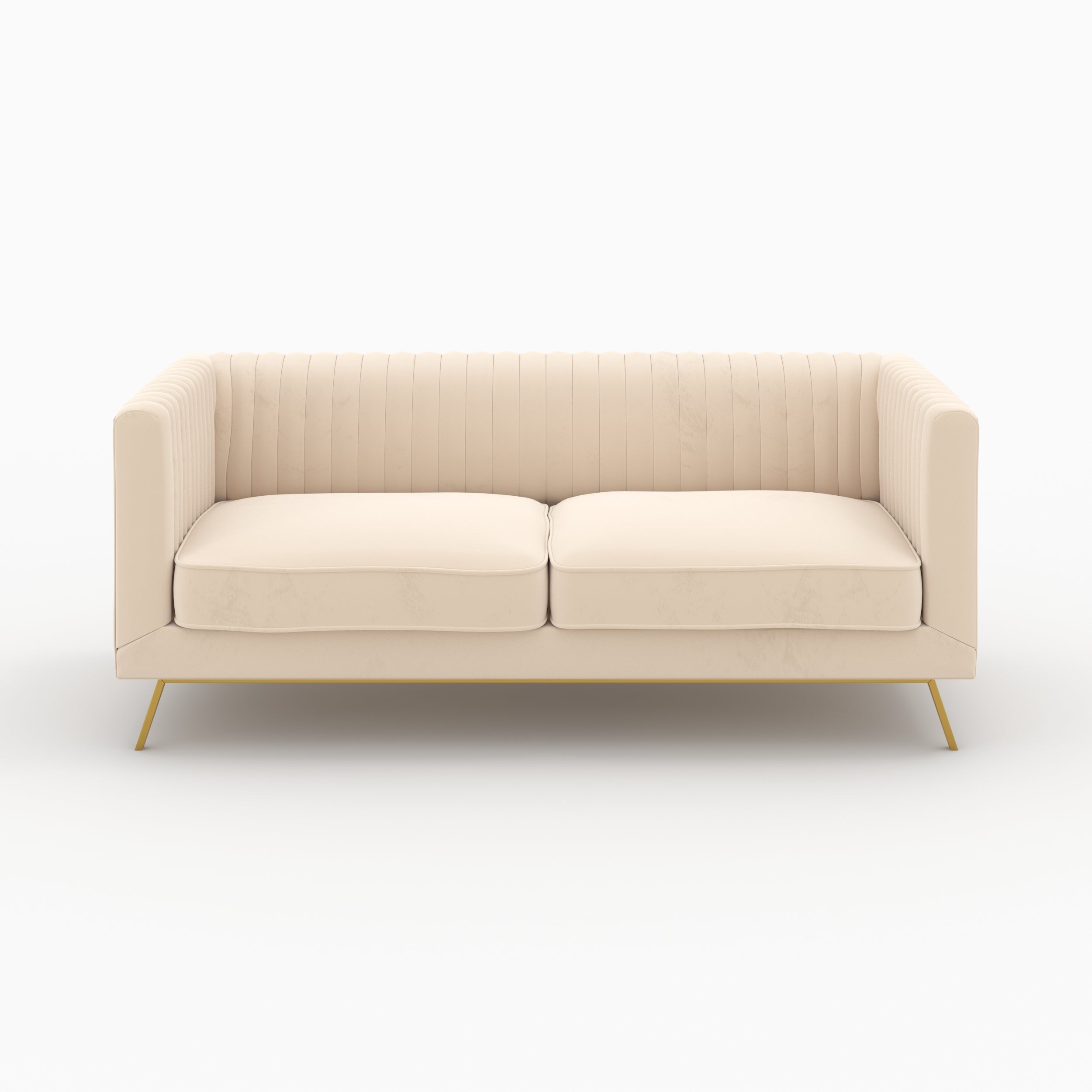
Designed to seat two people, the two-seater sofa fits into any space thanks to its compact size: it is primarily suited to small spaces or can complement another sofa in a large living room. If you are a professional, it can easily brighten up a waiting room or an open-plan office with a relaxation area.
The three-seater sofa
Designed to seat three people, or two people who enjoy extra comfort, the three-seater sofa is another option to consider for small spaces, where it offers greater comfort. It will also naturally find its place in a more spacious room.
The modular sofa
The modular sofa is the star of living rooms that embrace generous proportions. Made up of several elements—shorter or longer seats, armless chairs, left- or right-hand corner seats, chaise longues and more—that can be arranged as you wish, it generally offers three, four or even five seats. It is the ideal companion for large living rooms and families, while its corner elements can fill the corners of the room.
The chaise longue
A chaise longue is an L-shaped sofa with a long seat, a backrest and sometimes an armrest. Meaning “midday” and dating back to Antiquity, it was often used for eating in a semi-reclined position. It is the ultimate charming sofa: highly visual and comfortable, it is perfect for stretching out your legs. It is often used as an additional decorative piece or as a modular element on a sofa with a chaise longue or armless chair.
The sofa bed or convertible sofa
A sofa by day and a bed by night, the sofa bed is the ally of small spaces and those who regularly welcome family and friends. Whether it converts into a two- or three-seater, for everyday use in small spaces or occasional use, the range is extensive.
How can you find a good-quality sofa online?
Online, a sofa’s quality is verified in the product description, not in the photo. Three categories of information should be read before ordering: actual dimensions, the furniture’s composition, and delivery and assembly conditions. A seller who publishes all three enables you to make an informed decision; a seller who publishes none is asking you to take a gamble.
Dimensions to check on a product page
Do not focus solely on the sofa’s overall dimensions. A Maison Pavane product page indicates the number of seats, the seat width and depth, and the package dimensions. These three details do not convey the same information: the first indicates capacity, the second actual comfort, and the third whether delivery is feasible.
It is the package dimensions that must be compared with your door, stairwell and elevator—not those of the assembled sofa. A sofa that fits in your living room but not through your staircase will remain on the landing.
The sofa’s composition
Look for the structural material, upholstery and, when provided, foam density. These are the three details that distinguish a sofa that will last for years from one that will sag. A product page that mentions only the color and style tells you nothing about the furniture.
On a Maison Pavane product page, the structural material and upholstery material are specified for each product. Then refer to the quality criteria detailed above to interpret these values.
Assembly and delivery
Finally, check whether the sofa arrives assembled or requires assembly, and what kind. On our product pages, assembly details are specified: assembling the legs does not involve the same amount of work as assembling an entire piece of furniture. This information prevents unpleasant surprises on delivery day.
Want to see our sofa collection? They are waiting for you on our dedicated page.
How do you choose your sofa color?
The sofa color should be chosen according to the color of the room’s walls. Light walls call for a dark or bold-colored sofa. Dark or bright walls call for a light sofa. With young children, light shades are more susceptible to stains.

The sofa is one of the most important pieces of furniture in your living room. As the central element where you will spend long hours reading, chatting, playing or watching a movie, it will accompany you for several years. Beyond size, shape and material, color has a direct impact on the room’s decor and style.
- If your walls are light or very light, it is best not to choose a light sofa: you can opt for bold colors, warm colors or dark colors. A dark, black, chocolate brown or dark gray sofa will also highlight your other furniture.
- If your walls are darker or brightly colored, reverse the logic: choose a light-colored sofa that will instantly stand out and enhance the color of your walls or wallpaper.
At the forefront of current trends, colors are making a statement. Dreaming of an ultra-retro yellow cocoon or a sofa in soft blue velvet? Whether it is a low model with a small backrest and a minimalist, timeless design, or one with extra-wide armrests, your next favorite piece is waiting in our pages.

Which sofa style should you choose?
Three style families dominate: retro, with natural rattan and the return of velvet; Scandinavian, characterized by elegant simplicity; and vintage, embodied by Chesterfield sofas and aged leather. Style should be chosen last, once comfort and dimensions have been settled.
If you choose natural rattan seating, you will bring a delightfully retro touch to your interior. For a jungle-inspired look, add plants; to perfect a timeworn atmosphere, pair this seat with furniture featuring antique-shop charm.
The return of retro style can also be seen in the prominent role given to velvet, available in trendy colors. Timeless gray has never stopped appealing to lovers of classic elegance, in anthracite as well as lighter shades. This enthusiasm is also evident in Scandinavian-style models, which fit perfectly into every interior.
On the vintage side, certain timeless classics remain, such as the Chesterfield sofa, equally at home in a cozy, distinctly British atmosphere or an industrial club-style setting. The passion for aged leather steeped in history continues to inspire us, and we offer our own interpretations in faux leather, with an added eco-conscious touch. Our Gatsby three-seater sofa in dark blue velvet is a perfect example of this style.
Once you have chosen your sofa, you can add complementary furniture and seating to the room. Rattan, faux leather or fabric armchairs and ottomans will help structure the space. The coffee table will be important, whether used alone or as a nesting-table set, while our selection of rugs will complete the look.
FAQ: choosing the right sofa
What criteria should you check before buying a sofa online?
Six criteria: size, shape, intended use, structure, upholstery and seating type. On the product page, prioritize the seat dimensions, package dimensions, structural material and assembly details.
What sofa size is best for a small living room?
The two-seater sofa fits into any space thanks to its compact size. Designed to seat two people, it is suitable for small living rooms and first purchases, and can also complement another sofa in a large living area. An armchair can also serve as additional seating: see our guide to choosing an armchair based on the available space.
When should you choose a modular sofa?
A modular sofa is the ideal companion for large living rooms and families. Made up of several elements—long seats, armless chairs, left- and right-hand corners, chaise longues and more—it generally offers three to five seats and can fill the corners of the living room.
How can you recognize a good-quality sofa?
First look at the structure and crossbars, preferably made of wood. Then check for springs, with NO SAG or ZIG ZAG systems providing good elasticity. Finally, check the seat and backrest lengths in relation to your height: your back should be supported and your legs should not be restricted.
Which upholstery should you choose for a sofa in a home with pets?
Polyester and microfiber. Polyester resists abrasions and cat claws, dries quickly and does not attract dust. Thanks to its very tightly woven threads, microfiber is waterproof and resistant to both stains and scratches.
How do you measure a sofa’s footprint before buying it?
Clear the intended space, then mark out the floor area using a few cardboard boxes and painter’s tape. This will help you understand the model’s actual size in your room before ordering.
How can you check that a sofa will fit into your home?
Compare the package dimensions—not those of the assembled sofa—with your home’s door, the stairs in your house or building, and the elevator. It is the package that must make the entire journey to the living area.