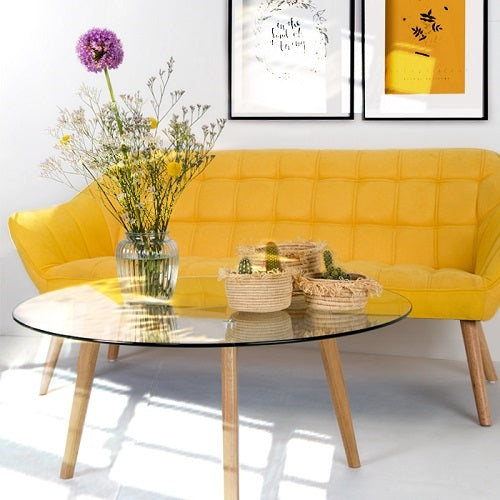
As the happy owner of one or more glass furniture pieces, you never tire of watching this beautiful material play with light and reflections while adding an ultra-contemporary, airy touch to your decor.
But now horrible fingerprints, or worse still, terrible scratches have appeared and are threatening the integrity of your interior design. Don’t panic! With simple household products, a little patience and plenty of determination, it is entirely possible to bring your glass furniture back to life.
The essentials
- To clean a glass table without leaving streaks, a damp sponge or cloth is enough: unlike wood, glass does not absorb any liquid.
- Choose distilled water over tap water: as it contains no minerals, it leaves no marks on glass.
- Avoid paper towels, which leave residue, as well as abrasive products and scouring pads, which scratch the tabletop.
- Depending on the stain: washing-up liquid for coffee, wine or soft drinks, white vinegar or lemon juice for fruit and grease, methylated spirits for glue, ink and water-based paint.
- Light scratches can be reduced with polishing paste, ash on damp felt or toothpaste; deep scratches cannot be repaired.
How do you properly clean glass furniture without leaving streaks?
To clean a glass table without leaving streaks, wipe it with a damp sponge or cloth, then dry it with a clean cloth. Glass does not absorb any liquid: wine, tea and coffee are easily removed. Paper towels should be avoided, as should abrasive products and scouring pads.

Cleaning a glass table is easier than you might think, especially when you know the right techniques. Even though a glass table may get dirty more quickly than tables made from other materials, it is easy to wash. In addition, glass is highly resistant to stains. Unlike wood, it does not absorb any liquid. So if you spill drinks such as wine, tea or coffee, all you need is a damp sponge or cloth to remove the dirt after a meal.
Warning: It is strongly recommended not to use paper towels to wipe your glass table, as they may leave unwanted paper residue. The same applies to abrasive products and scouring pads, which may accidentally scratch the tabletop of your glass table.
What are the best tips for polishing and cleaning stains from a glass table?
Each stain has its own product: washing-up liquid for food stains, white vinegar or lemon juice for fruit and grease, and methylated spirits for glue, ink and water-based paint. Rolled-up newspaper used as a pad makes particularly dirty surfaces shine.
| Product | Stains and uses |
|---|---|
| Washing-up liquid | Everyday food stains: coffee, wine, soft drinks |
| White vinegar | Fruit stains (strawberries, raspberries, grapes), grease stains; disinfects and adds shine |
| Lemon juice | Has the same properties as white vinegar, with a pleasant scent |
| Methylated spirits, in small amounts | Stubborn stains: glue, ink, water-based paint |
| Distilled water | Streak-free cleaning and rinsing, as it contains no minerals |
| Water mixed with a few drops of ammonia | Finger marks and fingerprints |
Simple cleaning solutions are available to restore the shine to all kinds of glass furniture (glass tables, glass coffee tables, etc.) and give them a new lease of life. The simplest and least expensive solution is to soak a piece of rolled-up newspaper and use it as a pad. Please note that this method is recommended for particularly dirty surfaces.
Unfortunately, your designer glass furniture cannot escape fingerprints. But this is not inevitable! There is a simple and effective method to prevent your glass table from becoming covered in fingerprints. To do this, use a very soft cloth soaked in a mixture of water and a few drops of ammonia. Rub gently in small circles. Success guaranteed in just a few seconds!
As for the stains that attack your glass table every day, there are many techniques and products that can be used to properly clean all types of unwanted marks:
Washing-up liquid
One of the best techniques for cleaning your glass table is simply to use a damp cloth with a little washing-up liquid and gently rub the stain. This very simple method will remove many stains left by food products such as coffee, wine and soft drinks.
White vinegar
Often used as a household cleaner, white vinegar is particularly effective for washing glass surfaces or removing stains from wooden furniture. It will help eliminate many stains, particularly those left by fruit such as strawberries, raspberries and grapes, as well as grease stains. It disinfects your dining table and restores shine to the glass tabletop.
Lemon juice
Lemon juice can be used for cleaning! With the same properties as white vinegar, it will help remove many stains and make your table shine just as effectively. In addition, lemon juice leaves a pleasant scent. To use it, cut a lemon in half and rub the zest directly onto your glass tabletop. Let the juice dry, then rinse your table with a sponge soaked in clean water. You can then dry the tabletop with a clean cloth or a ball of rolled-up newspaper.
Alcohol above 70%
Methylated spirits, used in small amounts, can also be a good solution for cleaning a glass tabletop. It will remove stubborn stains such as glue, ink and water-based paint. Other techniques and products can also be used to ensure that glass furniture is properly cleaned, such as glass cleaner, baking soda and bleach. However, bleach may leave unwanted marks, so care must be taken when using it.
Distilled water
When cleaning a glass table, we often do not necessarily consider the type of water we use. This is why, even when applying a “classic” glass-cleaning product, we very often notice small annoying marks remaining at the end. To solve this minor problem, simply avoid tap water and opt for distilled water. This water will not leave any marks when applied to the glass surface, as it contains no minerals, unlike tap water.
How do you maintain and clean a scratched glass table?
Only light scratches can be reduced. Three methods work on a glass table: repolish the surface with polishing paste and felt, rub it with damp felt sprinkled with ash, or apply toothpaste. Deep scratches cannot be repaired; at best, they can be made less visible.
A scratch on your glass table means it’s time to get serious: how can you remove scratches from glass furniture? Before you begin, take a close look at the scratches in question.
Are they superficial or deep? Let’s be honest: if the damage is severe, it will be difficult to remedy. At best, you will be able to reduce them slightly and make them less visible.
For light scratches, there are several solutions that have all proven effective. One involves repolishing the glass surface with polishing paste and a little felt. You can also gently rub the glass with damp felt sprinkled with a little ash. By making small circles as gently as possible, you will soon see the scratches gradually fade. The process should be repeated several times for optimal results.
An even easier technique for removing and concealing scratches is simply to use toothpaste: it can remove the small scuffs that make the table look old.
Correcting defects in your glass furniture is quite laborious but not impossible. Be patient and persistent—your decor depends on it!
How do you protect and keep a glass table clean?
To protect a glass table, place a plastic film, tablecloth or transparent wipe-clean table covering over it: this layer acts as a barrier against sharp and heavy objects. Place centrepieces on a table runner or a placemat, and clean the table several times a week to prevent dust from building up.
Glass is known to be a very delicate material, so precautions must be taken and its fragility recognised. A glass table is therefore a fragile piece of furniture that can quickly become damaged, scratched or even broken if care is not taken.
There is a quick and effective solution for avoiding the slightest mark and all the problems that may follow on your glass table. Especially if you use it every day, there are many ways to use your glass table as an everyday surface while taking no risk of damaging it. You can simply place a plastic film, tablecloth or transparent wipe-clean table covering over your glass table. These will act as a thin protective barrier against sharp materials and heavy objects that could damage the table.
If you want to add decoration to your glass table, such as a centrepiece (vase, candles, etc.), you should also place it on a table runner or placemat laid on the table, to protect the table properly.
To keep your glass table clean, one of the best solutions is therefore to protect it properly with a tablecloth or plastic film. In any case, cleaning should not be neglected; try to do it as regularly as possible to prevent dust from accumulating. It is therefore preferable to clean it several times a week.

Of all your furniture, your glass coffee table is probably the one that requires the most attention (knocks, glass marks, dust, etc.). But it is well worth the effort, as glass—a natural, elegant and timeless material—will never go out of fashion! If it is the central feature of your living room, don’t neglect it!
FAQ: cleaning a glass table
How do you clean a glass table without streaks?
Clean the glass table with a cloth or damp sponge, using distilled water rather than tap water: as it contains no minerals, it leaves no marks. Dry with a clean cloth or a ball of rolled-up newspaper, never with paper towels.
How do you remove fingerprints from glass furniture?
Soak a very soft cloth in a mixture of water and a few drops of ammonia, then gently rub in small circles. The result is achieved in just a few seconds. This method prevents designer glass furniture from remaining covered in fingerprints.
Which product should not be used on a glass table?
Paper towels leave paper residue, while abrasive products and scouring pads scratch the tabletop. Bleach may leave unwanted marks and requires caution. Tap water, which is rich in minerals, leaves small annoying marks after drying.
Can you remove a scratch from a glass table?
Light scratches can be reduced with polishing paste and felt, ash sprinkled on damp felt, or toothpaste. The process should be repeated several times. Deep scratches cannot be removed; at best, they can be made less visible.